
 EN
EN 

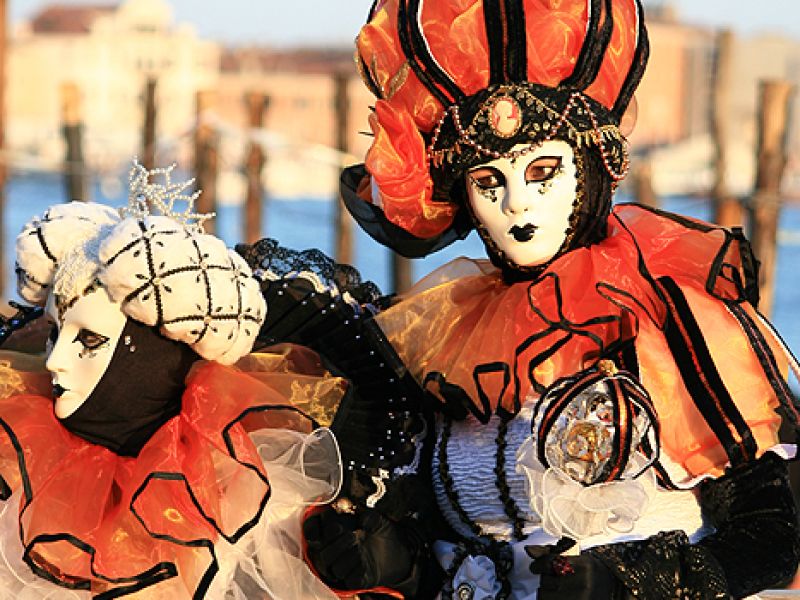
The Venice Carnival, which in some ways recalls the Roman Saturnalia and the Dionysian cults of the Greeks, has its roots in 13th-century society and, despite various decrees issued to limit its excesses (more for public order than for moral reasons), it was celebrated regularly until the decline of the Serenissima Republic, when Napoleon handed it over to Austria with the Treaty of Campo Formio (1797). Chroniclers tell that in the days before Lent people of every class and nationality, masked with bauta, moretta or domino, poured into the city, crowding the lanes and squares or going to the theatres, cafés, gaming rooms and casini, and the halls of ancient patrician palaces. On different stages and among different temptations, during the Venice Carnival the powerful and the humble, nobles and common people alike, gave themselves over with delight to games and shows. So Venice, a strictly oligarchic republic, gave the humbler classes the illusion of becoming like the powerful!
In this way social tensions were eased and consent was maintained (the Romans’ ancient “panem et circenses”). At Carnival time the people watched the official celebrations in the public square, above all those of Giovedì Grasso (Fat Thursday), namely the Forze d’Ercole (human pyramids) and the Volo del Turco (an acrobat who came down a rope from the bell tower of St Mark’s), today replaced by the Volo della Colombina. There were also fireworks and improvised shows by tumblers, tightrope walkers, puppeteers and street artists, all activities regulated by the State. Alongside these public celebrations, many private parties were held during the Carnival in patrician houses and palaces, with lavish balls and, often, gambling.
In this climate of licence and euphoria, the Ridotto of San Moisè, the public gaming house run by the State, became one of the focal points of the Venice Carnival: how many princes, how many Italian and foreign nobles, “protected” by their masks (unlike the croupiers, the so-called barnabotti, impoverished Venetian noblemen), squandered their fortunes there! The most important days of the Carnival were, then as now, Fat Thursday and Shrove Tuesday. Fat Thursday was reserved for the parades of blacksmiths, craftsmen and butchers. After the parade, garlanded bulls were led to St Mark’s Square and beheaded in the presence of the Doge; the celebration then continued with fireworks and the daring Flight from the Bell Tower of St Mark’s (see above). Shrove Tuesday was the climax of the festivities, with parades of masks, singing and dancing until the stroke of midnight. The fall of the Republic therefore also marked the end of the Venice Carnival. However, after a long pause, it was revived in the 1980s with a new face, still attractive even if not very respectful of traditional customs.
The Carnival celebrations
During the Carnival days Venice blossoms with events and shows, from those improvised in the street by many street artists to those planned by the organisers. Every year a central theme is chosen as a common thread and developed from various points of view, from the cultural to the purely spectacular. The heart of the festival is still St Mark’s Square, where a huge stage is built; but there are many events elsewhere too, partly to avoid excessive crowding in a city where you can only get around on foot. So the squares host historical parades, concerts, various shows and fireworks; many venues have live music; the theatres stage comedies and ballets, and exclusive parties are held in sumptuous patrician palaces. Everywhere Venice teems with tourists and visitors.
Carnival today
As always in the lagoon city, you walk a lot: to look at the masks in the magnificent Venetian setting, to mingle with the crowd in homemade disguises or to be photographed in grand costumes made to amaze, and to experience the old libertine spirit in its more commercial form. In recent years this important event has in fact lost much of the spontaneity that brought it back to life in the early 1980s: in some ways the Venice Carnival, now the object of sponsorship and promotions, seems to have been “embalmed” in a catwalk of elaborate and very expensive costumes, worn with an air of self-importance out of place and out of time. Still, being lenient with the conformists, we must give Venice credit for preserving and conveying the charm of being unique.

