
 EN
EN 

The Museum of the Cathedral of Santo Stefano in Caorle is run on behalf of the Parish
by the Sant’Apollonia Association. Set up in 1975 in the rooms of the bishops’ former private chapel,
the Museum holds objects linked to worship and devotion, such as chalices, reliquaries, crosses,
liturgical vestments and the famous six 14th-century icons.
Summer opening hours
Saturday 8 pm-10 pm
Sunday 10 am-12 noon / 8 pm-10 pm
For more information please contact the Sant’Apollonia Association
Tel. 0412702464
Fax 0412702458
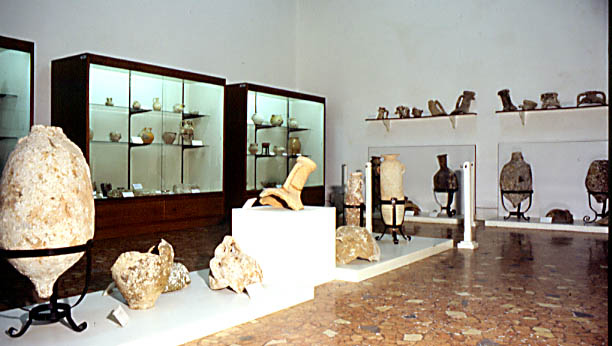
MUSEUM - Archaeology Room
The room displays many different finds of Roman, Byzantine and medieval production. The first display cabinet, on the left as you enter, holds terracotta kitchenware: water jars; a fragment of a marble door jamb, a small marble column, amphorae for special uses (cinerary), a basin, etc.
These objects, mostly Roman, are all explained, if briefly, by captions. The second and third cabinets, on the left as you enter, hold: earthenware and ceramic vessels, Palaeo-Venetian cups, foundation bricks and various other items recovered from the sea, a Byzantine parazonium sword, basins with floral decoration, an Islamic vase, a ceremonial dish with a dancer beating a drum, medieval crucibles, etc.
The three cases with sloping lids in front of the entrance contain (from left to right):
a) Potsherds of various shapes and colours from the late Middle Ages and the Renaissance (12th-16th century), found in 1986 during excavation work on the sea wall in front of Caorle Cathedral and in front of the municipal police station in Piazza Vescovado;
b) Terracotta oil lamps of various types, fragments, a Roman dagger, a terracotta coin mould, a lead hawser ring, various clay remains;
c) 18th-century terracotta pipes, fossil shells, a Venetian touchstone and more. On the shelves: necks and fragments of Roman amphorae of various types, all numbered and classified (from the 3rd century BC to the 2nd century AD).
On the floor, on a platform: whole and partly broken Roman and Carthaginian amphorae; wheel-shaped grain millstones, various bricks, lead stocks of Roman anchors, stone mortars, etc. Above the display cases are panels explaining the history of the material and drawings reconstructing amphorae and anchors.
In the archive (in the archaeology room):
A collection of over 1,000 black-and-white negatives of old photographs, with matching postcard prints for selection and for ordering copies for journalism, teaching, research and other uses.
They show views of the town centre, the lagoon and the sea, local activities (fishing, hunting, farming, tourism), boatbuilding (the squero), bathing and more. In essence, this room bears witness to history from the 3rd century BC to the 17th century AD.
MUSEUM - Ethnology Room
The Ethnology Room tells the story of Caorle from the Middle Ages onwards. On entering, on the left you can see a letter with a group photo of “Pioneers”, some of the soldiers stationed in Caorle during the First World War. The author of the letter describes his medical role and his kindness towards the people of the Caorle area, to whom he secretly passed quinine to fight malaria (very widespread at the time because of the Anopheles mosquito, which bred massively in the reed beds and marshes of the fishing valleys and lagoons). On the wall: four certificates of merit for agricultural and livestock production awarded by the government of the time (1930s) to the Ca’ Corniani farm estate in Caorle (a very important farming, livestock, wine and aquaculture hamlet). The large Italian tricolour flag with the Savoy coat of arms, hung by a man from Caorle from the double window of the bell chamber of Caorle’s cylindrical bell tower at the end of the First World War, while the Austrians were still there.
To the right of the Italian flag, a photo of “Gramola” (Nicolò Gallo), who made the gesture on 30.10.1918, and an extract of the account from a history book of the time.
Below and beside the Italian flag: photographs of the Squero (boatyard) and a panorama of Caorle seen from the bell chamber in the 1920s; a group photo of Austrian sailors with their commander (Mr Benussi), who, among the many ports visited in his long and honourable career under the Austro-Hungarian flag and with His Majesty’s ships, lists the port of Falconera in Caorle first among the Italian ones; a dish with ceramics hand-painted by fellow townswoman Carlotta Romiati Prosdocimi and, below it, on midnight-blue sackcloth, a drawing of corncobs made from their husks; a wooden cabbage slicer with a trapdoor and a guillotine blade operated by hand pressure.
On the shelf: various carpentry, hunting, farming and household tools, all captioned.
On the back wall, in the left corner, on a platform: a reconstruction of a rural hearth with various accessories: chains (ciavedon) and a cauldron hanging under the hood, a coffee roaster and grinder, bellows for the fire, various irons, and “dalmine” and “socoi” (wooden clogs of different shapes), closed and half-open, for the stable and damp places, used in the countryside.
On the hearth platform: a swift and a spindle, the first for winding and the second for twisting wool, cotton and other plant fibres.
To the right of the hearth: a double-barrelled hunting gun; a brown frame with photographic tiles and, in the centre, a map of Caorle’s second farm estate (Chiggiato estate) in the 1920s. Below, at the sides, two plates with blue designs and Latin mottos, reproduced and hand-painted by Mrs Carlotta Romiati Prosdocimi.
Below the frame, in the centre: a wooden carrier for bringing buckets of water from the fountain or well to the house; a handmade bread chest decorated on the sides with hand-painted majolica showing scenes of 1930s rural life and slogans linked to the famous “Battle for Grain”.
The work of Mrs Carlotta Romiati Prosdocimi.
These items illustrate the tools of carpentry, for which Caorle was rightly famous as early as the time of the Serenissima Republic, and of rural life, particularly intense in the vast hinterland (5,000 hectares), both under the colonate system and in well-organised, self-sufficient farm estates.
Corner with “Ara and Sopa”:
A glimpse of the lagoon is reproduced, with the “cason” and the “casonetto”, typical huts of marsh reed.
Fishermen and their families lived in the first for work during long periods of the year, especially at the time of the “Fraima”, a word from the Latin “Infra-Hieme”, meaning under winter, on the threshold of winter. On 8 September, in fact, most of the fishermen gathered in the Rio (Caorle’s inner harbour) and, after the priest’s blessing, set off in boats of various shapes and sizes towards the lagoons, where they stayed in the “cason” until 22 December, two days before Christmas.
The exodus was also called “Madonna dei Fagotti” (Madonna of the Bundles) as well as Fraima, because it fell on 8 September, the Nativity of the Blessed Virgin, when good wishes set off “in form”, physically represented by the bundles, the packages and belongings, clothes and household goods, piled on the bows and decks of the boats; on top of them, like living figureheads, crouched dogs and cats, which also had a specific job once at the casone (the dogs kept guard and the cats hunted rats and mice, clearing the place of fish bones).
The “casoneto” held “i arnesi”, the tools of the trade: oars, oarlocks, “marotte”, “masi” (net markers), coils of rope, thread for mending torn nets, etc.
The Ara was, and is, the end of a waterway, the remains of a watercourse cut off by land reclamation, where the “sopa” was made by raising the level of the marshy ground (reed bed), digging and piling “velma” soil (mud sloping from the bank to the bed of watercourses, canals and stretches of water between the valleys) within the chosen area. It is worth noting that the ditch left by the digging was used as a fish pond, that is a holding tank for the fish caught, which was then sold, eaten or bartered for other farm produce.
The casone was built on the “sopa”, with a frame of wooden planks and ribs made from the trunks and branches of robinia or acacia, and a roof of bundles of marsh reed, skilfully arranged and tied with wicker and long, flexible branches of poplar and tamarisk.
The “Ara” got its name because it was the agronomic unit of measurement of 100 m², roughly the size of the “sopa”.
On the wall above: a fresco of the setting with valley birds.
Below the model, in the three niches:
a) the evolution and types of Caorle fishing boats;
b) the batea or lagoon sandolo (Sampierotto type);
c) objects and utensils from the “cason”.
On the bench opposite the entrance: fishing and hunting tools; handmade decoys for waterfowl (marafoni) of “pavera” (marsh grass); “squaleneri”, nets for warty crabs and spider crabs; a large tackle called “taja” for hauling the Bragozzo ashore and dragging the fish net onto the deck of the boat; a “bujol” (wooden bucket with a handle, carried on the forearm in the valley); a “cofojn” (flat basket for displaying fish); a “canestrin” (for draining fish before frying). A narrow-hulled Bragozzo of the “sadeliero” type (sardines were caught by hoisting a lantern on a pole jutting out from the bow), and a paraffin lantern used on the “sadeliero”.
Unlike the similar boat called “Tamoche”, with a slightly wider hull, this fishing boat had no foremast, because the space gained by removing it (the deck) was used to unload the fish hauled up with the tackle and held in the bag of the “tratta” net, which, once hoisted, was emptied by undoing a knot at the bottom of the bag.
On the wall behind the bench opposite: a series of naming charts with illustrated drawings of the stages and ways of rigging the sails of the bragozzo and how they were made. On the left: the original image of the Madonna dell’Angelo, patron saint of Caorle’s fishermen, who by tradition kept it both in the casone and on board the bragozzo. The present statue, on the altar of the church dedicated to the Madonna dell’Angelo, was carved in Val Gardena, blessed on 19 July 1923 by Cardinal Patriarch Pietro La Fontaine in the Basilica della Salute in Venice and brought to Caorle in a procession at sea on 21 July.
On the right: a panel illustrating Venetian rowing boats, and therefore partly also those of Caorle. Original period maps of the Caorle area and its rivers.
On the right-hand wall as you enter: lagoon and sea animal species; an “Admiralty” type anchor whose weight tensions the rope that holds up the two bragozzo sails hanging above, under the ceiling of the room, which are original sails; a piece of the upper part (gota) with a winged angel on a pitch-black background and, below it, sections of the “falca” (the band marking the planking along both sides at deck level) with religious symbols (a dove) and apotropaic ones such as the dragon (symbols or drawings meant to ward off the fear of death).
On the central platform: a “tamoche” type Bragozzo with sails, from the 1930s-1940s, for general fishing with the saccoleva (tratta) net. The one on display is a toy model built by the “Fumolo” (Marchesan family), whose children used it to race similar boats of friends their age at the water’s edge.
A “Caorlina” boat, actually 10 metres long, rowed by 6 men with one at the stern steering with an oar. A lagoon fishing boat (the version for coastal navigation had a sail). The Caorlina was widely used until the end of the 1920s. Then it was replaced by the Bragozzo when, in 1929, fishing moved from the lagoon to the sea because of the reclamation of the land between the lagoons and valleys.
In its heyday it was rowed by the “Compagnie di Tratta” (net crews) which, along the Baseleghe and Dei Lovi canals, at the far eastern end of the Caorle municipality, fished very profitably for sturgeon, gilthead bream, sea bass, “cagnoi” (a kind of small edible shark, also called “asià”), eels, large eels, “volpine”, grey mullet, etc. The net crews could number up to 100 people each.
For the “mestiereti”, small-scale fishing, the Batea was used, a flat boat rowed by one or two men (a scale model is displayed in the central niche of the valley corner).
At the head of the platform: the Pajolo (cauldron), which, as displayed, was placed on a brazier inside the stern hatch of the Bragozzo to cook the daily meals (before gas stoves were adopted).
The brazier, made from a box of wooden planks, was lined inside with tin, insulated from the wood by filling the gaps with sand.
At the foot of the platform wall: a samovar. Not part of traditional local culture, it is linked to the emigration of people from Caorle to Russia for work at the time the Trans-Siberian Railway was being built.
Above the platform, in the centre:
A late medieval small cannon (bombardella) found in the sea, used on the stern castle of Venetian galleys or galleons (14th to 16th century). On the base, cannonballs of different periods and calibres.
Along the sides of the platform: punt guns (s’cioponi) for hunting birds in the valleys and lagoons of Caorle.
The gun was laid along the centre line of the “batea”, with the barrel sticking out over the bow knob and the butt resting on the thwart; here the hunter crouched, waiting to spot a flock of waterfowl, and fired, sometimes killing as many as 150 birds with a single shot. In those days this was not a massacre but a thinning out of a habitat densely populated by resident and migrating birds. Most of the birds shot were replaced by the massive migratory flow over a lagoon area very rich in food.
Game supplemented the fish-based diet, and bunches of “masurini” (mallards) were a sought-after currency for exchanging and bartering raw materials in Portogruaro as well as in Venice.

